Are you considering a new career as an instructional coach? Instructional coaching is sweeping through classrooms. An instructional coach works in the classroom, observing how a teacher performs while applying teaching methods, and makes suggestions for dynamic improvements.
Instructional coaching is a form of embedded learning, and it is growing in popularity because it is shown to be highly effective. If you seek a career transition in education, making a move from teacher to instructional coach can reinvigorate your career while applying and sharing your teaching expertise and wisdom.
If you are already in the education field and seeking to bring new life to your career, consider using your teaching expertise to become an instructional coach. Teachers with strong teaching experience and an excellent track record are well qualified to monitor the performance of less experienced teachers and provide feedback on teaching style and techniques.
Administrators, principals, and headteachers who have managed many different teaching programs across various teaching methods have also shown to be adept at instructing teachers in the classroom.
These transitioning educators have an itch to return to an educational environment where they ultimately feel their talent lies. Alternatively, you may be looking to transition back or re-enter teaching.
Instructional coaching’s strength is its focus on bringing evidence-based practices into the classroom. Whether it is a literacy program or a new math teaching application, the instruction method has improved academic performance. Ideally, the coach is an experienced teacher who has successfully applied the teaching techniques she is coaching. She understands its strengths and weaknesses, as well as how different learners’ styles will interact with the instructional method.
8 Tips to Transition from a Teacher to an Instructional Coach Role
For 16 years, I have worked with educators seeking a career change; I guide them on a rewarding, stress-free path to a happy, successful life. We do more than write teacher resumes. We create many other documents and provide interview preparation and career consulting.
Many of my career-change clients are now meeting the demand for instructional coaches and finding fulfilling careers where they can practically apply their extensive teaching experience. To help you with your own career transition, here are strategies to help you transition from teaching to instructional coaching.
Let’s get started!
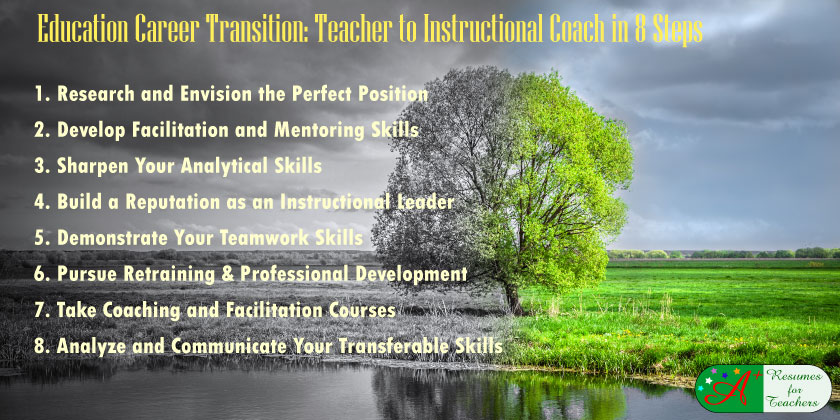
1. Research and Envision the Perfect Position
As an instructional coach, you will facilitate the use of evidence-based teaching methods in the classroom by providing direct coaching to the teacher. Your objectives are to improve teaching style and effectiveness, student engagement, and learning to improve academic achievement. Instructional coaches can also play a larger consultancy role.
Initially, you may be required to work closely with headteachers, principals, and superintendents to assess current teaching methods across multiple classrooms, identify areas for improvement, and introduce new teaching methods.
Each school district and school will have its own requirements for an instructional coach, and the job responsibilities can vary greatly. Furthermore, you will be required to work in accordance with state standards and district strategic plans.
Envision how you will look in the role of an instructional coach. Ask yourself, what aspects of the job would I enjoy the most? You could be drawn on more for content expertise than for teaching methods. Ask yourself, am I interested? Qualified? To find out, conduct a career assessment, personality, and skills inventory.
2. Develop Your Facilitation and Mentoring Skills
Beyond your experience working with students, seek opportunities to coach/facilitate professionals who require less direct instruction and more facilitation.
Facilitation has a different connotation from coaching. Coaching includes the man on the sidelines of a soccer game barking commands at team players. Facilitation involves guiding others to be the best version of themselves.
The facilitator provides the support structure, knowledge, tools, and techniques to help a teacher improve her skills. Whenever possible, a good facilitator will provide prompts and direction to help a teacher identify and correct actions, if necessary. The instructional coach encourages teachers to be more reflective and to think critically and analytically.
3. Hone Analytical Skills
Your ultimate success as an instructional coach will come down to the numbers – more specifically, academic performance improvements. Instructional coach objectives will be measured. You will need to demonstrate that you can track and analyze performance and present related data in reports and charts. Evidence-based practices must be followed meticulously, and performance and achievements must be recorded. Individual class and school performance require being in alignment with state and district plans and objectives.
4. Build a Reputation as an Instructional Leader in the School District
The more credibility you have in the teaching community, the more efficient you will be as an instructional coach in the classroom. A trusted and respected teacher produces more positive learning outcomes. Your classroom teaching record will speak for itself. Take advantage of after-school and community programs to introduce your teaching skills to a wider community.
5. Demonstrate Teamwork Skills
The hotshot coach’s model, getting paid big bucks for delivering superior performance, is rare even in sports. Instructional coaches need to be super collaborators and team players. Working collaboratively with classroom teachers is a critical aspect of the role. You will fail in your coaching endeavor if you undermine the teacher’s competency in front of the students. Implementing new teaching methods requires co-planning with principals, headteachers, and education boards.
Coaching in front of a classroom requires sensitivity and strong human relations skills. Even experienced educators could benefit from exploring how to discover and communicate on-the-job strengths and weaknesses.
6. Pursue Retraining & Professional Development as an Instructional Coach
Returning to school is a fabulous professional learning opportunity to strengthen any weak areas in your new career direction. Professional development or retraining will provide you with a greater understanding of the role and newly fortified skills to perform it. The school may also provide an employment service and help you retain employment in instructional coaching.
7. Take Coaching and Facilitation Courses
The business community is also embracing coaching in higher numbers. Because of this, numerous training programs are now available. Becoming a certified coach and/or facilitator will show that you have the ability to facilitate other teachers. Such special qualifications could get your instructional coach’s letter of interest noticed and your resume prioritized.
8. Analyze Your Transferable Skills to Include in Your Instructional Coach Resume
Establish your resume objective for instructional coaching jobs. What content or instructional areas would you enjoy coaching others in?
Take a close look at your teaching skills and identify those that transfer across different instructional coaching opportunities. Many teachers can provide teaching methods (e.g., guided reading, everyday math) and content areas (e.g., math, science). You may have expertise in using technology (e.g., SMART Board, iPads, mobile technology) in the classroom to improve learning outcomes. Conduct a skills assessment of what skills and competencies you could offer as an instructional coach.
Developing teacher capacity can be an enriching career for a mid-career educator.
Many educators relish the opportunity to draw on their expertise and wisdom from a career in education to mentor other teachers and help them be more effective in the classroom. Coaching is also a highly transferable skill. Instructional coaching in education could prepare for a third career move, such as a transition from a school teacher to a corporate trainer, or serve as a stepping stone to education administration.
Kickstart your education career transition by reading up on job search strategies for career advancement. Read journals, attend conferences, and join associations in your areas of expertise to gather further knowledge. As an instructional coach, you are similar to an education consultant in many ways and are expected to be an expert in the domain you consult in.
For more information, explore how a career transition coach can help you launch your career change.
Please find out more about Candace Alstad-Davies by reviewing this about me page. From that page, you can review testimonials and frequently asked questions.
Need us to write a top-notch, attention-grabbing instructional coach resume, application letter, LinkedIn profile, philosophy statement, or a curriculum vitae (CV)?
Look no further.
Take the time to review and order one of our resume packages or individual services.
Have questions? Please connect by emailing Candace or calling toll-free at 1-877-738-8052. I would enjoy chatting with you.